
Home › Products › Low pressure valves › Butterfly valves › Ductile iron lug
Ductile iron - lug type - stocked 2 inch to 4 inchDuctile iron lug type butterfly valve, 2" to 4"
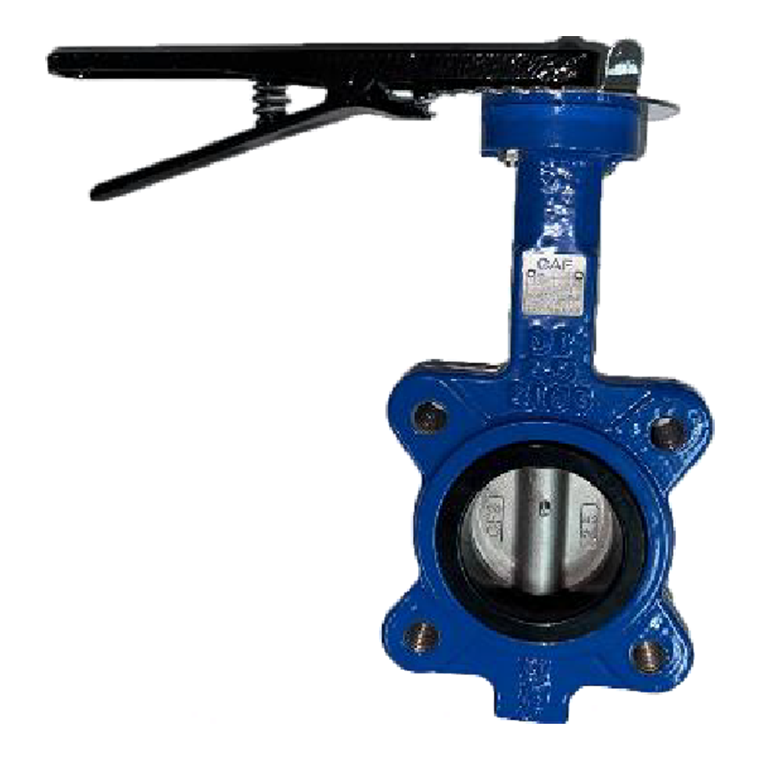
Tapped lugs, so each pipe flange bolts on independently — the ductile iron body style that can end a line. CF8 disc, EPDM seat, drilled and tapped for ANSI 150#.
The ductile iron lug type
The tougher body in our butterfly range.
A resilient‑seated butterfly valve with a ductile iron body, a CF8 cast stainless disc on an SS410 shaft, and an EPDM seat liner — the same construction as the cast iron lug type, in a body with far higher tensile and impact strength. Designed, dimensioned face‑to‑face and tested to API 609 / API 598.
We stock 2" to 4" (DN50 to DN100); the catalogue publishes 1½" to 6" and the other sizes can be brought in.
- The lug body is the one that can end a line. Its tapped holes let each flange bolt on independently, so the downstream pipe can come off with the valve shut and holding pressure — the one practical thing a wafer body cannot do.
- ANSI 150# only. Unlike the ductile iron wafer, which is drilled for four flange standards, the lug body is tapped for ANSI 150 alone — tapped holes commit to one thread and one circle.
- Ductile iron takes shock and pipe loads that grey cast iron will not — the usual pick where a line vibrates, gets walked on, or sees water hammer.
- ⚠ Two different rubbers, with opposite compatibility. The seat is EPDM and the shaft O‑ring is NBR. The catalogue lists the medium as general oil, gas and water, as printed — but EPDM is poor with mineral oil and it is the pressure boundary, so tell us the fluid before you order. The compatibility table.
- ⚠ Check disc clearance before bolting up. On the smaller sizes the disc swings past the body face as it opens and can foul a reducer, a pump flange or a lined pipe.
- No gaskets against the pipe flanges. The EPDM seat has raised faces that seal directly against them; an extra gasket makes the joint worse.
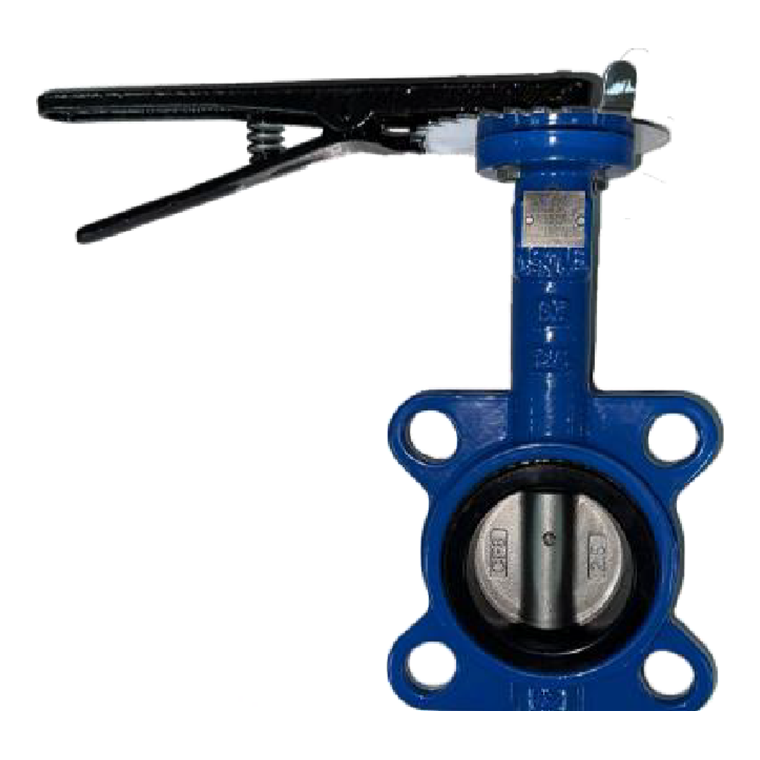
The stocked valve, photographed. From the manufacturer’s catalogue.
Specification
Everything that goes on a purchase order.
| Stocked sizes | 2" to 4" (DN50 to DN100) · catalogue publishes 1½" to 6" |
| Body style | Lug type — also stocked as the ductile iron wafer type and in cast iron |
| Drilling | ANSI 150#, tapped lugs |
| Body | Ductile iron |
| Disc | CF8 in the bill of materials; SS304 in the part descriptions — the same 304 family, stated both ways |
| Seat | EPDM — and it is the pressure boundary |
| Shaft | SS410, pinned with SS304, in polymer bushings |
| Shaft seal | NBR O‑ring |
| Handle | Ductile iron lever with a notched locking plate |
| Design · face‑to‑face · testing | API 609 · API 609 · API 598 |
| Working pressure | 150 PSI per the catalogue · nominal 1.6 MPa per the test table — read them below |
| Working temperature | −30 °C to 120 °C |
| Parts in the list | 8 — identical on both body styles |
| Catalogue | Lug type PDF — direct download below |
| Stock | Held in Malaysia or Singapore |
Bill of materials
8 parts — identical on the wafer and lug bodies.
| No | Part name | Material |
|---|---|---|
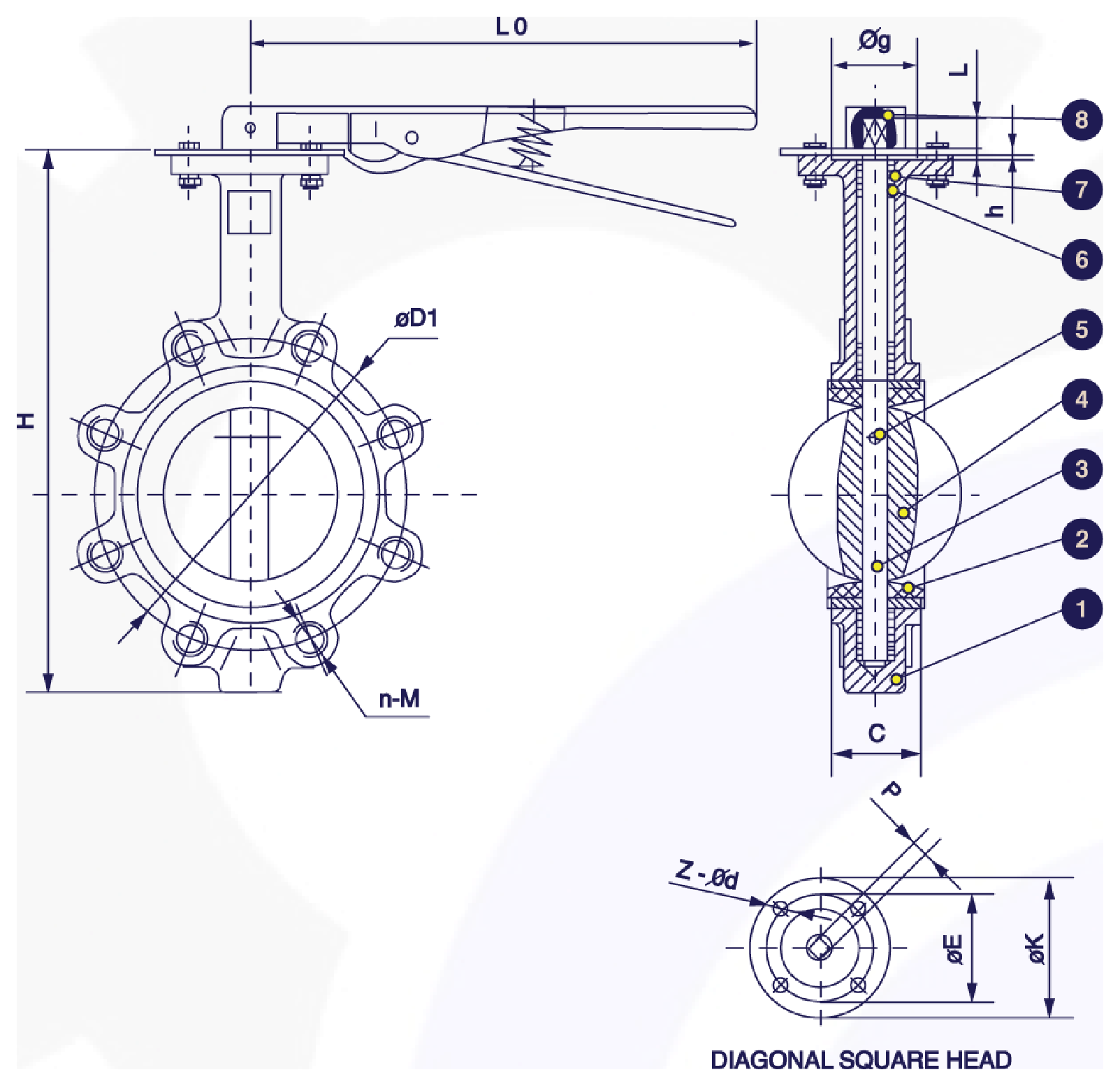
| 1 | Body | Ductile iron |
| 2 | Seat | EPDM |
| 3 | Shaft | SS410 |
| 4 | Disc | CF8 |
| 5 | Pin | SS304 |
| 6 | Bushing | Polymers |
| 7 | Oring | NBR |
| 8 | Handle Lever | Ductile iron |
The manufacturer’s sectional drawing. Callout numbers correspond to the parts list above.
- ⚠ The seat is the part to specify. EPDM suits water, hot water and air and is poor with mineral oil. A different liner is a specification, not a modification — say so before you order.
- The disc is stated two ways in the source — CF8 in the bill of materials, SS304 in the part descriptions. Both are the 304 family; we quote both as printed.
- ⚠ The part numbers read VL‑CI‑BU‑L‑150‑xx, as printed — the same codes as the cast iron lug valve — while the descriptions say ductile iron body. Until the factory clarifies, write “ductile iron” in words on the order rather than relying on the code alone; we do the same on our purchase orders.
Sizes and dimensions
Seven sizes, as the catalogue prints them. Dimensions in millimetres.
| DN | Size | Height H | Disc C | Face‑to‑face L | P | L0 | Top flange K | Top flange E | Top flange z‑d | Top flange g | Top flange h | ANSI 150 D1 | Tapped n‑M |
|---|---|---|---|---|---|---|---|---|---|---|---|---|---|
| 40 | 1 1/2" | 214 | 33.4 | 24 | 9 | 220 | 65 | 50 | 4-7 | 35 | 2.2 | 99 | 4-1/2" |
| 50 | 2" | 242 | 35 | 27 | 9 | 220 | 65 | 50 | 4-7 | 35 | 2.2 | 120.5 | 4-5/8" |
| 65 | 2 1/2" | 265 | 45 | 24 | 9 | 220 | 65 | 50 | 4-7 | 35 | 2.2 | 139.5 | 4-5/8" |
| 80 | 3" | 278 | 45.5 | 24 | 9 | 220 | 65 | 50 | 4-7 | 35 | 2.2 | 152.5 | 4-5/8" |
| 100 | 4" | 315 | 51 | 25 | 11 | 255 | 90 | 70 | 4-9 | 36 | 2.2 | 190.5 | 8-5/8" |
| 125 | 5" | 343 | 54 | 25 | 14 | 260 | 90 | 70 | 4-9 | 36 | 2.2 | 216 | 8-3/4" |
| 150 | 6" | 369 | 55 | 27 | 14 | 260 | 90 | 70 | 4-9 | 36 | 2.2 | 241.5 | 8-3/4" |
- This table matches the cast iron lug valve dimension for dimension — the same pattern body in a different iron. Bolt counts follow ASME B16.5: 4 tapped holes per side up to 3", 8 from 4" upward.
- The top flange is published — 4‑7 on ø50 up to 3", 4‑9 on ø70 from 4" — with a diagonal square head on the stem, so a gearbox or actuator bolts straight on.
- ⚠ Leave clearance for the disc, not just for the body. On the smaller sizes the disc protrudes past the body face when open.
Test pressure and temperature
As the lug type catalogue prints them.
| Nominal pressure | 1.6 MPa (232 PSI) |
| Shell test | 2.4 MPa |
| Sealing test | 1.76 MPa |
| Working temperature | −30 to 120 °C |
| Working pressure, features page | 150 PSI |
- The published nominal is 1.6 MPa (232 PSI) with the exact 1.5× and 1.1× test multipliers of a PN16 valve — while the features page states 150 PSI, and the wafer type’s catalogue prints a 1.0 MPa nominal. All figures as printed: design to 150 PSI unless we confirm otherwise.
- ⚠ Shell and sealing tests are proof tests, not working pressures. Do not design to them.
- −30 to 120 °C is the rubber, not the iron. The EPDM seat and NBR O‑ring set the ceiling. For hot duty use a metal‑seated gate valve.
Questions we get asked
The ones that come up on the phone.
How is this different from the cast iron version?
The body is ductile iron, which has far higher tensile and impact strength than grey cast iron — the pick where a line vibrates or sees water hammer. The internals — CF8 disc, SS410 shaft, EPDM seat, NBR O‑ring — are the same as the cast iron lug type.
Wafer or lug?
Lug if the valve is near the end of a line — its tapped holes let each flange bolt on independently, so the downstream pipe can come off with the valve holding pressure. A wafer body is clamped between two flanges and cannot do that — but the ductile iron wafer is the one drilled for four flange standards. This page is the lug; the wafer type is here.
Which sizes do you stock?
2" to 4" (DN50 to DN100), held in Malaysia or Singapore. The catalogue publishes 1½" to 6" — the other sizes can be brought in; tell us the quantity and the date you need them.
Is it 150 PSI?
The catalogue states 150 PSI working pressure, and its test table prints a nominal of 1.6 MPa (232 PSI). Those two differ — the 1.6 MPa nominal carries exact PN16 test multipliers. We publish everything as printed: design to 150 PSI unless we confirm otherwise.
Can I use it on oil?
The catalogue lists the medium as general oil, gas and water, as printed — but the seat is EPDM, which swells in mineral oil, and on a butterfly valve the seat is the pressure boundary. Our advice: water and air yes; oil, use a ball valve — or tell us the exact fluid and we will confirm the seat with the factory.
Why do the part numbers say CI on a ductile iron valve?
As printed, this catalogue’s part numbers read VL‑CI‑BU‑L‑150‑xx — the same codes as the cast iron lug valve — while the descriptions say ductile iron body. Until the factory clarifies, write “ductile iron” in words on the order; we do the same on our purchase orders.
Can I fit an actuator or gearbox?
Yes — the drawing publishes the top flange (4‑7 on ø50 up to 3", 4‑9 on ø70 from 4") and a diagonal square head on the stem, so a gearbox or quarter‑turn actuator bolts straight on. Send the actuator make and model and we confirm the fit before you order either half.
Does it need flange gaskets?
No, and they make the joint worse. The EPDM seat has raised faces that seal directly against the pipe flanges. Bolt the flanges straight onto the seat and pull up evenly.
Catalogue
Direct PDF download — no form, no email address.
Send the size and the fluid
We will confirm the EPDM seat suits what is in your line, check the drilling against your flange standard, and quote a landed price. Stock in Malaysia and Singapore.